
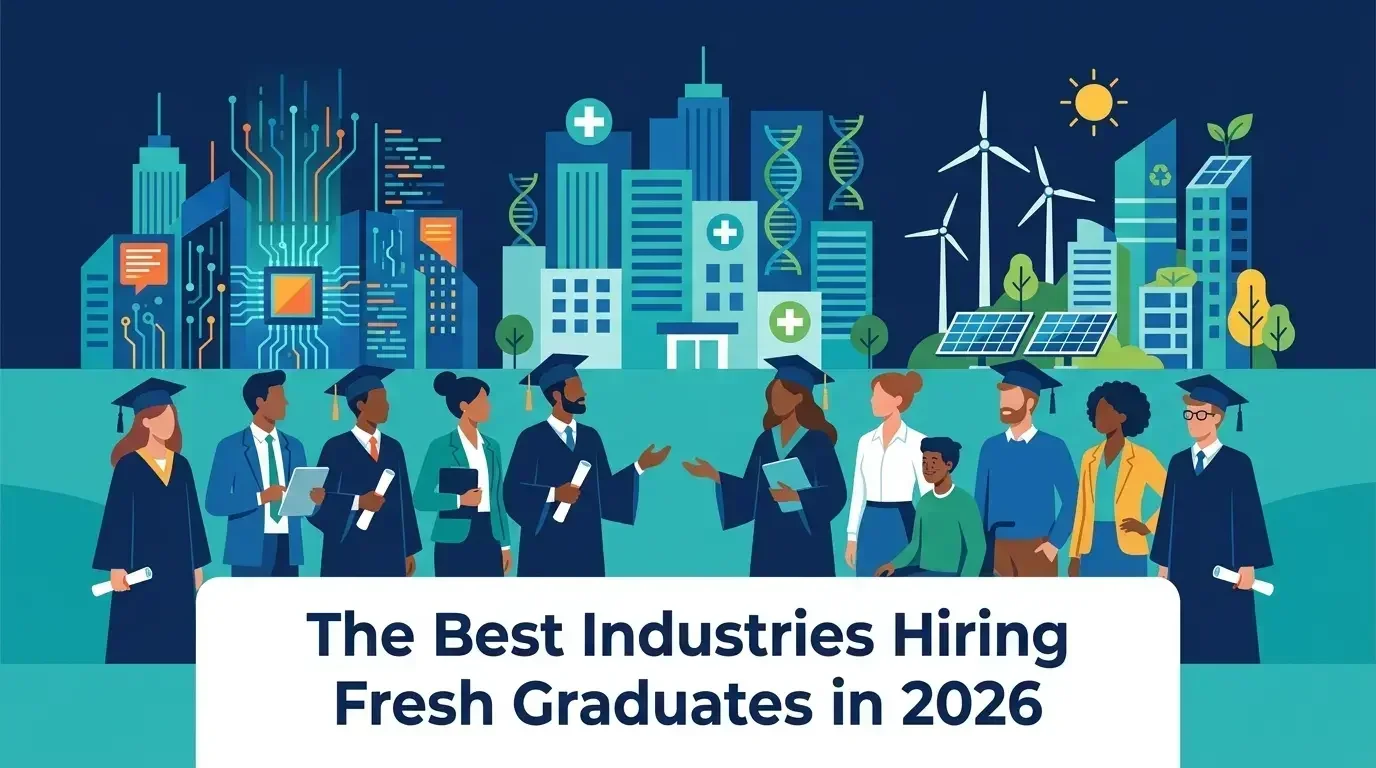
Choosing where to apply matters more than how many places you apply. A graduate who targets three industries strategically will get more callbacks than one who sends 80 applications everywhere with no clear focus. The industries below are actively hiring fresh graduates in 2026, offer real entry-level pathways, and don't require years of experience to break into. Each one includes the roles you should target, what the work actually looks like, and exactly how to position yourself as a candidate with no track record yet.
What Makes an Industry Good for Fresh Graduates
Not every growing industry is graduate-friendly. Some sectors hire heavily at the top and barely at the bottom. The industries on this list meet three criteria: they have high entry-level vacancy rates, they offer structured development pathways so you're not stuck in the same role for five years, and they don't gate entry behind professional qualifications that take years to obtain.
Salary ranges below reflect typical starting figures for entry-level roles. They vary by location, company size, and specific role, but they give you a realistic benchmark before you walk into a negotiation or accept an offer without knowing whether it's fair.
The Best Industries Hiring Fresh Graduates in 2026
1. Technology and Software
Tech remains the single most active sector for graduate hiring globally. The demand for software developers, data analysts, product managers, and UX designers hasn't cooled, and companies across every vertical, from fintech to e-commerce to healthcare, are building internal tech teams that need junior talent.
You don't need a computer science degree to break into tech in 2026. Companies are hiring graduates from any discipline for roles like junior data analyst, product operations associate, technical support specialist, and QA tester. What they want is evidence that you can learn quickly, work with data, and think systematically.
Entry-level roles to target: Junior Software Developer, Data Analyst, QA Engineer, Technical Support Analyst, Product Operations Associate.
Skills that get you hired: SQL, Excel, Python basics, Figma, JIRA, Notion, and any evidence of self-directed learning like a Coursera certificate or a personal project on GitHub.
How to break in: Apply directly through company careers pages, not just job boards. Most mid-size tech companies post graduate roles 4 to 6 weeks before their intake starts. Set up alerts for "graduate programme" and "junior" on LinkedIn filtered to the Tech industry and check them daily.
2. Financial Services and Fintech
Banks, insurance firms, and fintech startups hire in volume at the graduate level every year. The difference in 2026 is that fintech companies are now competing seriously with traditional banks for the same candidates, which means more options, more variety in role type, and in many cases better starting salaries outside the traditional banking track.
Entry-level finance roles don't always require a finance degree. Analytical thinking, attention to detail, and comfort working with numbers matter more than your specific academic background for roles like operations analyst, risk associate, and client services officer.
Entry-level roles to target: Operations Analyst, Credit Analyst, Risk Associate, Client Services Officer, Compliance Support Analyst, Graduate Trainee (most major banks run structured programmes).
Skills that get you hired: Excel at an intermediate level minimum, basic financial modelling awareness, attention to detail, and any exposure to accounting software like QuickBooks or Sage is a bonus.
How to break in: Graduate programmes at major banks typically open applications between September and November for the following year's intake. Missing that window doesn't close the sector off. Fintech startups and smaller financial services firms hire year-round without the formal programme structure. Target both tracks simultaneously.
3. Marketing, Advertising, and Digital Media
Every company in 2026 needs content. Every company needs someone who understands social media, SEO, email marketing, and paid digital. The gap between demand and supply is significant at the junior level because most marketing degrees teach theory while companies need people who can open a dashboard and report on what's actually working.
If you've run a social media account, created content, written copy, or managed any kind of online presence, even for a student society or a personal project, that counts as relevant experience for a marketing role. Frame it correctly on your resume and it will get you interviews.
Entry-level roles to target: Marketing Assistant, Social Media Coordinator, Content Writer, SEO Analyst, Email Marketing Associate, Digital Marketing Executive.
Skills that get you hired: Google Analytics, Meta Business Suite, Canva, Mailchimp, basic SEO knowledge (keyword research and on-page optimisation), and a portfolio of any content you've created, even if it was unpaid.
How to break in: Build a portfolio before you apply. Even three pieces of well-written content or three examples of social media work with engagement data attached give you something concrete to show. Agencies are a strong first move because they expose you to multiple industries and clients in your first year, accelerating your learning faster than a single in-house role typically does.
4. Healthcare and Pharmaceuticals
Healthcare is one of the most recession-resistant sectors for graduate employment. Demand for healthcare workers, administrators, researchers, and support staff is growing across clinical and non-clinical tracks, and the pharmaceutical industry specifically has been expanding its graduate intake since 2022.
You don't have to be a doctor or a nurse to build a career in healthcare. Non-clinical roles in healthcare administration, medical sales, clinical research, and public health coordination are consistently hiring graduates from science, business, and social science backgrounds.
Entry-level roles to target: Medical Sales Representative, Clinical Research Associate, Healthcare Administrator, Public Health Officer, Pharmaceutical Graduate Trainee, Hospital Operations Analyst.
Skills that get you hired: Attention to detail, data literacy, regulatory awareness for clinical roles, and strong written communication for administrative and coordination roles. For medical sales, confidence and persistence matter more than a science degree.
How to break in: Pharmaceutical companies and hospital networks run structured graduate schemes. Research which companies have active schemes in your country and apply 3 to 4 months before their posted deadlines. For medical sales specifically, a strong cover letter that demonstrates commercial awareness and communication skills will outweigh a generic application almost every time.
5. Consulting and Professional Services
The big four accounting firms, management consultancies, and specialist advisory firms collectively hire thousands of graduates every year. These roles are competitive, but they're not as selective as their reputations suggest if you know how to prepare.
What consulting firms are really looking for at the graduate level is structured thinking, clear communication, and the ability to analyse a problem and present a logical recommendation. You don't need to have consulted on anything before. You need to demonstrate that you can think clearly under pressure.
Entry-level roles to target: Graduate Analyst, Business Analyst, Audit Associate, Tax Associate, Strategy Analyst, Operations Consultant (Junior).
Skills that get you hired: Excel, PowerPoint, structured written communication, and the ability to do a case study interview. Most consulting firms use case interviews as part of their selection process. Practise these specifically before applying.
How to break in: Apply early. Most graduate programmes at consulting firms close in October and November for the following year's intake. Missing the window means waiting 12 months. Set a calendar reminder for September and have your application materials ready before then. For smaller boutique consultancies, applications are accepted year-round and competition is significantly lower.
6. Education and EdTech
The education sector is hiring across both traditional and digital tracks. Schools, training organisations, and government education agencies consistently recruit graduates, particularly in STEM subjects where teacher shortages are acute. On the tech side, EdTech companies building learning platforms, tutoring tools, and corporate training products are growing rapidly and hiring junior content designers, curriculum developers, and customer success roles.
Entry-level roles to target: Graduate Teacher (PGCE or teaching qualification routes), Instructional Designer, Curriculum Developer, EdTech Customer Success Associate, Learning and Development Coordinator.
Skills that get you hired: Subject expertise for teaching roles, content writing and instructional design skills for EdTech, and comfort with learning management systems like Moodle, Canvas, or TalentLMS for L&D roles.
How to break in: Teaching routes vary by country, but most have structured graduate entry pathways that provide salary support during training. For EdTech, treat your application like a marketing role, show evidence that you can explain complex ideas clearly, because that's 80% of what the job requires.
7. Logistics, Supply Chain, and E-Commerce Operations
This is the most underrated sector on this list for graduates. E-commerce growth over the last five years has created a structural shortage of entry-level supply chain talent, and most graduates aren't targeting it because it doesn't have the brand appeal of tech or finance. That gap works in your favour.
Supply chain roles pay well at the entry level, offer rapid progression, and expose you to operations, data, vendor management, and commercial decision-making within the first 12 months. The skills you build transfer across every industry.
Entry-level roles to target: Supply Chain Analyst, Logistics Coordinator, Operations Associate, Procurement Analyst, Inventory Analyst, E-Commerce Operations Executive.
Skills that get you hired: Excel, data analysis basics, process thinking, and any exposure to ERP systems like SAP or Oracle is a significant advantage. You don't need prior logistics experience. You need to demonstrate that you can manage complexity and work with numbers.
How to break in: Target large retailers, FMCG companies, and e-commerce businesses directly. These companies have the highest volume of entry-level supply chain vacancies and the most structured onboarding for graduates who haven't worked in the sector before.
How to Pick the Right Industry for You
- Match your skills to the sector's hiring criteria first, your passion second. Passion without relevant skills won't get you through a screening. Relevant skills without passion will get you a job you can grow into. Start with where you're credible, then find the companies within that sector whose work genuinely interests you.
- Research salary benchmarks before you apply so you know what fair compensation looks like at the entry level in your chosen sector. Walking into a negotiation without this information is the most avoidable mistake graduates make.
- Pick two sectors, not seven. Spreading your applications across every industry dilutes your focus and makes your materials generic. Choose two related sectors, tailor your resume and cover letter for each, and apply with depth rather than breadth.
- Check the growth trajectory, not just current hiring volume. A sector hiring heavily today because of a temporary spike is different from one with structural long-term demand. Tech, healthcare, and logistics all have structural demand. Sectors tied to single economic cycles are riskier bets for a first role.
Frequently Asked Questions
Which industry pays the most for fresh graduates in 2026?
Financial services and technology consistently offer the highest starting salaries for entry-level graduates. Roles in investment banking, software engineering, and data analytics typically come with the strongest compensation packages at the junior level. Consulting at the big four and major management consultancies also pays above average for graduates. Healthcare and logistics tend to start lower but offer strong progression and stability. The highest-paid first role isn't always the best long-term move. A lower starting salary in a sector with fast progression and strong skill development can put you further ahead financially within three years than a high starting salary with a slow career path.
Do I need a specific degree to get hired in these industries?
For most roles on this list, no. Technology companies are increasingly degree-agnostic for non-engineering roles, hiring graduates from humanities, social sciences, and business into data, product, and operations positions. Marketing and consulting firms care more about analytical thinking and communication skills than your specific degree subject. The exceptions are clinical healthcare roles, which require relevant qualifications, and chartered finance roles, which require specific professional examinations. For every other sector, your degree subject matters less than your skills, your portfolio, and your ability to articulate what you bring to the role.
How many industries should I target in my job search?
Two is the right number for most graduates. One primary sector where your skills and experience fit most naturally, and one secondary sector that overlaps with it. Targeting more than two spreads your preparation too thin and forces you to write generic applications that don't land. Targeting only one is risky if that sector slows down or your applications stall. Two sectors give you enough focus to tailor your materials properly while maintaining enough breadth to keep your options open. Once you've secured a role, you can always pivot. Your first job does not have to be your permanent direction.
Is it too late to break into these industries if I graduated more than a year ago?
No. Most of the sectors on this list don't gate entry on graduation year, and very few companies ask when you graduated on their application forms. What they care about is whether you have the skills and the attitude to do the role. If you graduated 18 months ago and haven't worked since, address the gap honestly in your cover letter: what you did during that period, what you learned, and what you're bringing to the role now. A gap doesn't disqualify you. An unexplained gap that you clearly haven't reflected on gives interviewers pause. Close that gap proactively and move forward.
Pick Your Sector and Start Applying This Week
Choose two sectors from this list that align with your skills and background. Update your LinkedIn headline to reflect the job title you're targeting in your primary sector. Then apply to 8 to 10 specific, tailored roles this week, not 40 generic ones next month.
Before you send anything, make sure your application materials are ready. Read our guide on how to write a resume with no experience and our walkthrough on how to write a cover letter that actually gets read so every application you send is doing its job properly.