
You've never had a "real" job. Your resume is mostly blank. And every entry-level listing you find asks for two to three years of experience you don't have.
Here's the truth: every recruiter screening your resume was once in exactly this position. A blank work history doesn't disqualify you. A badly structured resume does. The graduates who get interviews without experience aren't lying or padding their CVs. They're presenting what they do have in a way that signals potential, not absence.
This guide walks you through exactly how to write a resume with no experience that gets past applicant tracking systems, lands on a recruiter's desk, and convinces someone to bring you in. Follow every section in order. By the end, you'll have something that's ready to send today.
What Recruiters Actually Look For in Entry-Level Candidates
Stop trying to compete on work history. You don't have any, and neither does anyone else applying for the same roles. Entry-level recruiters know this.
What they're actually looking for is evidence that you can learn quickly, show up reliably, and contribute without needing three months of hand-holding. Your job is to prove those three things using the materials you already have: your education, your projects, your extracurriculars, and any unpaid or informal work you've done.
A recruiter spends an average of 6 to 7 seconds on a first pass of any resume. That's not enough time to read your bullet points. It's barely enough to scan your headings. So your structure, your layout, and the first thing they see in each section matter more than the content buried underneath it.
The Resume Sections That Matter When You Have No Experience
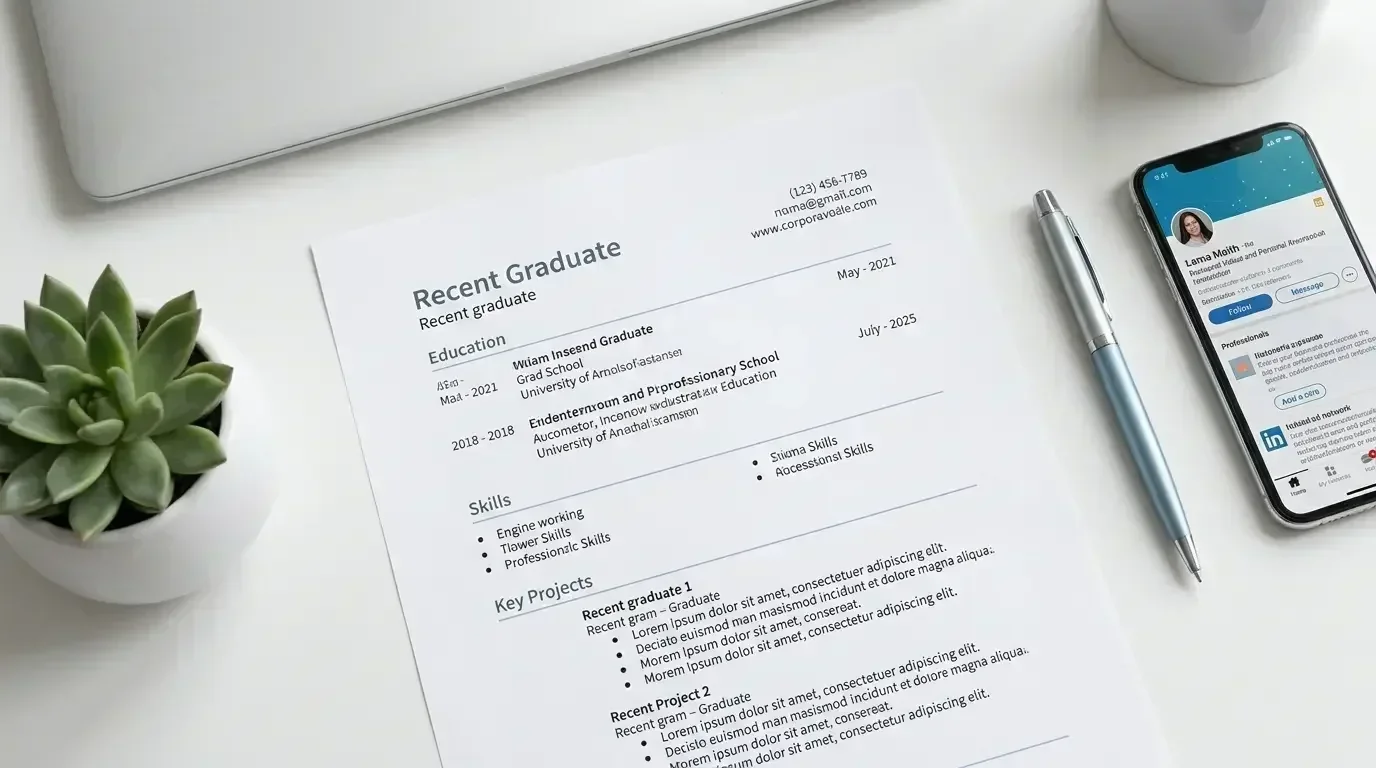
Most resume templates are designed for people who've had jobs. You need a different section order. Here's what yours should look like.
Lead With Your Name, Contact Info, and a Headline
Your name goes at the top. Below it: your email, your LinkedIn URL, your phone number, and your location (city and country only).
Below all of that, write a professional headline. Not "Recent Graduate." That tells a recruiter nothing. Instead, write the job title you're targeting followed by two or three relevant skills: Junior Marketing Assistant | SEO | Content Writing | Google Analytics. This is the first thing a recruiter reads after your name. Make it specific.
Education Section Comes Second
When you have no work experience, your education is your strongest credential. Put it second, right after your contact info.
Include your degree, your institution, your graduation year, and your GPA if it's 3.5 or above (or the local equivalent). Below that, list four to six relevant modules or coursework that connect to the job you're applying for. If you wrote a dissertation or completed a final-year project, include a one-line description.
Skills Section Comes Third
List technical skills only. Not "hard-working" or "team player." Those are opinions, not skills.
Good examples: Python, Excel, Figma, HubSpot, Google Analytics, Adobe Premiere, SQL, Canva, Salesforce, WordPress. Pull the keywords directly from the job description and include every one you genuinely know. Applicant tracking systems scan for exact-match keywords. If the listing says "Microsoft Excel" and you wrote "spreadsheets," you may not get through.
Projects and Coursework Come Fourth
This is where most graduates leave value on the table. A final-year dissertation, a group project, a university society role, a freelance job for a friend, or a personal side project all count here.
Format each entry like a job: the project name at the top, a one-line description, and two to three bullet points describing what you did and what the outcome was. Use numbers wherever possible. "Grew Instagram account from 200 to 1,400 followers in 3 months" is a result. "Managed social media" is not.
How to Write Bullet Points That Don't Sound Empty
This is where most no-experience resumes fall apart. Bullet points like "assisted with tasks" or "helped the team with various responsibilities" communicate nothing.
Every bullet point should follow this formula: action verb + what you did + the result or scale. Here are some before-and-after examples.
- Before: Helped with social media for the student union. After: Created and scheduled 3 posts per week across Instagram and Twitter for 2,200+ followers, increasing average engagement rate from 1.2% to 4.7%.
- Before: Organised events as part of the marketing society. After: Coordinated logistics for 4 speaker events attended by 80 to 150 students each, managing venue booking, catering, and email promotions.
- Before: Good at Excel. After: Built automated weekly reporting spreadsheets in Excel (VLOOKUP, PivotTables) that reduced manual data entry time by approximately 2 hours per week.
Numbers don't have to be exact. Estimates are fine. What they must do is force you to commit to a specific claim, which is the difference between a bullet point that reads like experience and one that reads like a job description.
Tailoring Your Resume for Each Application Without Rewriting It Every Time
Sending the same resume to 50 jobs is one of the most common mistakes graduates make. It's also one of the easiest to fix.
You don't need to rewrite your whole resume for each role. You need to change three things.
- Your headline. Match the exact job title in the listing.
- Your skills section. Make sure every keyword from the job description that applies to you appears on your resume.
- Your top two bullet points. Reorder them so the most relevant result appears first.
This takes about 8 to 12 minutes per application. It will meaningfully increase your callback rate because ATS filters and recruiters both prioritise relevance to the specific role over a generic submission that went to 50 companies.
Formatting Rules That Make Your Resume Pass the 6-Second Test
A resume that's hard to read doesn't get a second look. Get these basics right before you send anything.
- Use a clean, single-column layout for roles submitted through ATS portals. Two-column templates often break when parsed.
- Keep your resume to one page if you have fewer than two years of experience.
- Use 10 to 12pt font in a professional typeface: Arial, Calibri, or Georgia. Not Times New Roman.
- Leave enough white space. Margins of 0.75 to 1 inch on all sides help recruiters scan without squinting.
- Save as a PDF unless the application specifically asks for a Word document. PDFs preserve your formatting across every device.
- Do not include a photo, your date of birth, or your nationality. These details serve no purpose and introduce unconscious bias.
Common Resume Mistakes That Get Applications Rejected
- Generic objective statements. "Seeking a challenging role where I can grow" tells a recruiter nothing. Replace it with a targeted headline.
- Listing responsibilities instead of results. Every bullet should show what happened, not just what you were supposed to do.
- Using the same resume for every job. ATS filters reject untailored applications before a human ever sees them.
- Spelling and grammar errors. A single typo in your name, email, or opening line is enough for some recruiters to stop reading. Proofread three times. Then ask someone else to proofread once.
Frequently Asked Questions
Can I really get interviews with a completely blank resume?
You can, but "completely blank" is almost never accurate. Most graduates have at least two or three things worth including: a degree, a university project, a part-time job, or a personal project. The issue isn't that you have nothing. It's that you haven't framed what you have as experience yet. A well-formatted one-page resume built around your education, a strong skills section, and two or three project bullet points with real numbers will outperform a poorly written resume from someone with two years of irrelevant experience.
Should I include a cover letter if I have no experience?
Yes. A cover letter is one of the few places where you can explain the gap between what the job listing asks for and what you currently have. Keep it to three short paragraphs: why you want this specific role, what relevant skill or project you bring, and one sentence confirming you're ready to start and available to interview. Don't rehash your resume. Use the cover letter to say something your resume can't. Check out our guide on how to write a cover letter with no experience for a full walkthrough.
How long should my resume be when I have no experience?
One page. This is not up for debate at the entry level. Recruiters don't want to read two pages from someone who has never held a full-time role. If you're struggling to fill one page, you're including the wrong things. If you're struggling to cut it down to one page, you're including too many things. Either way, one page is the target. Keep section headings short, bullet points tight, and cut any line that doesn't add specific evidence of a skill or result.
What if I genuinely haven't done any projects or extracurriculars?
Start one today. A LinkedIn post about a topic relevant to the industry you're targeting, a free Coursera certificate, a small freelance job through Fiverr, or a GitHub repository with a project you built over two weekends all count. You don't need years of experience to demonstrate skill. You need one credible example that proves you're interested, capable, and proactive. Recruiters hiring graduates are not expecting a deep portfolio. They're looking for signal that you've done something beyond attending lectures.
Does the resume template or design matter?
Less than you think. A clean, well-structured plain resume beats a fancy designed one in most ATS systems. Design-heavy templates with graphics, columns, or icons often parse incorrectly and get flagged automatically. Choose a simple template in Word, Google Docs, or a tool like Teal or Resume.io that outputs a clean PDF. Spend your energy on the content, not the colours. No recruiter has ever hired someone because their resume had a nice font.
Your Resume Is Ready. Here's What to Do Next.
Upload your finished resume to LinkedIn in the "Open to Work" section and enable recruiter visibility. Update your LinkedIn headline to match the headline on your resume. Then apply to 10 to 15 targeted roles today, not 50 generic ones. Relevance outperforms volume every time.
For your next step, read our breakdown of the best entry-level job boards for recent graduates in 2026. Combined with a strong resume, knowing where to apply puts you ahead of most of the competition before anyone reads a single bullet point.