
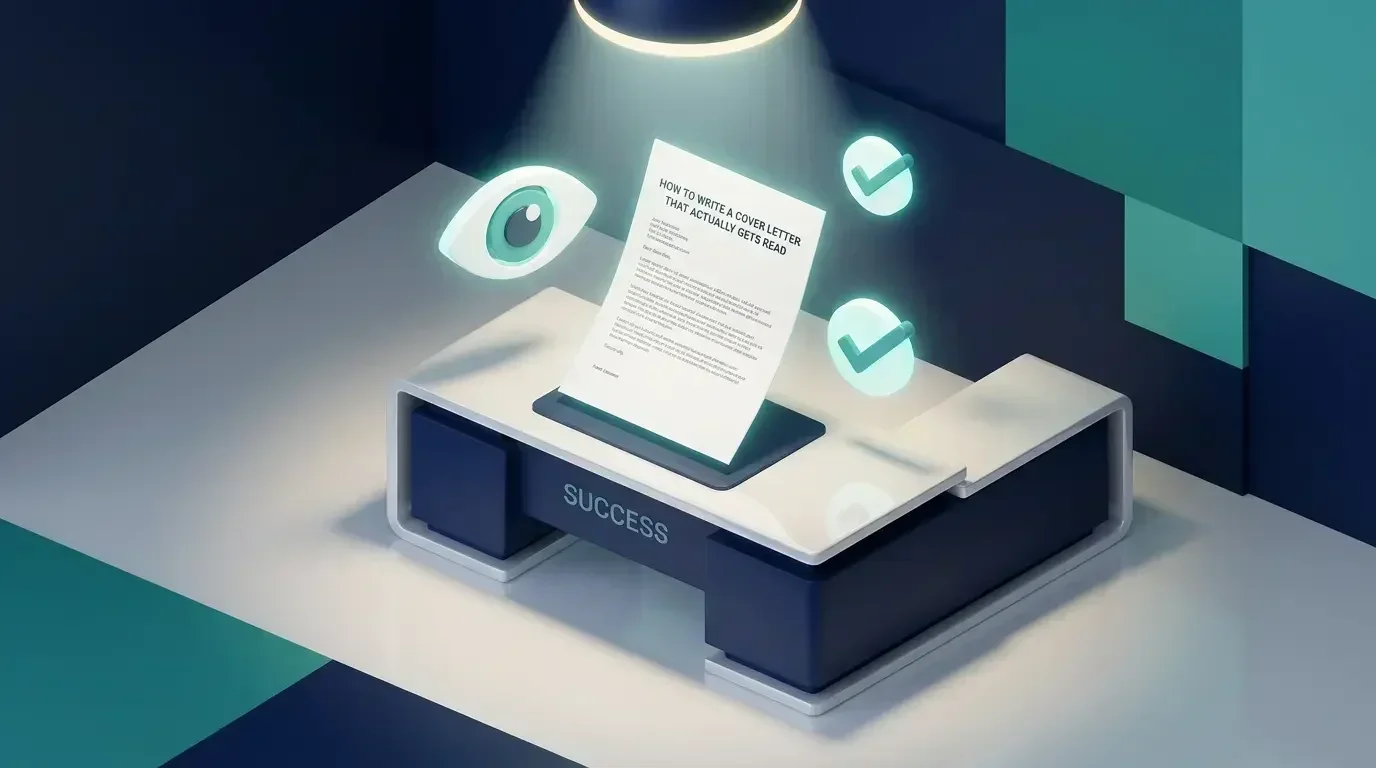
Most cover letters get skimmed for about 7 seconds before a recruiter decides whether to keep reading. The ones that survive that cut all have one thing in common: they say something specific about the company and the role in the first three lines. The ones that don't make it sound like they were copied from a template, because they were.
Writing a cover letter that actually gets read isn't about length, formatting, or following a rigid formula. It's about making a recruiter feel, immediately, that you understand what they need and that you're the person who can deliver it. This guide shows you exactly how to do that, section by section, with real before-and-after examples throughout.
Why Most Cover Letters Get Ignored Immediately
Recruiters read hundreds of cover letters for a single role. After the first dozen, the patterns become obvious. The same hollow opener, the same list of soft skills, the same closing line about "looking forward to hearing from you." None of it says anything. All of it wastes the reader's time.
The core problem is that most people write cover letters about themselves. They list their qualifications, restate their resume, and explain why they want the job. What they don't do is tell the recruiter what problem they solve. A cover letter that focuses entirely on you is the wrong document. A cover letter that focuses on the company's needs and how you meet them is the one that gets a response.
Roughly 47% of hiring managers say a cover letter is the first thing they read before the resume. Get it wrong and your resume may never be opened. Get it right and you've already separated yourself from the majority of applicants before anyone reads a single bullet point.
The Structure of a Cover Letter That Gets Results
Keep your cover letter to three paragraphs and one closing line. That's it. No long introductions, no five-paragraph essays, no restating every job you've held. Recruiters don't have time for it and it signals that you don't respect theirs.
Paragraph One: The Hook (2 to 3 Sentences)
Your first paragraph needs to do one thing: make the recruiter want to keep reading. Don't open with your name, your degree, or where you found the listing. Open with a specific observation about the company or role that shows you've actually paid attention.
Here's what that looks like in practice.
Wrong opener:
"I am writing to apply for the Marketing Assistant position at Acme Corp, which I found on LinkedIn. I am a recent graduate with a degree in Business and I believe I would be a great fit for your team."
Right opener:
"Acme Corp's pivot to short-form video content last quarter, specifically the LinkedIn series that hit 200,000 views, is exactly the direction I've been building skills toward. I want to help you scale that."
The second opener proves you've done your research. It references something real. It opens a conversation instead of making an announcement. That's enough to earn the next 30 seconds of a recruiter's attention.
Paragraph Two: The Evidence (3 to 4 Sentences)
This is where you make your case. Pick one specific result or project from your background that directly connects to what the job requires. One. Not three. Not a list of qualities. One concrete example with a number attached.
Wrong evidence paragraph:
"I am a highly motivated individual with strong communication skills, attention to detail, and the ability to work well in a team. I am also a quick learner who adapts easily to new environments."
Right evidence paragraph:
"During my final year, I managed social media for our university's entrepreneurship society, growing the Instagram account from 340 to 2,100 followers in 5 months by posting 4 times a week and running two live Q&A sessions with founders. The content strategy I built is still being used by the team I handed it to. That's the kind of work I want to bring to your marketing team."
The second version is specific, credible, and directly relevant to a marketing role. It gives the recruiter something to ask about in an interview. That's its job.
Paragraph Three: The Ask (2 Sentences)
Close with a direct ask. Don't "look forward to hearing from you at your earliest convenience." Don't apologise for taking up their time. Say you'd like to discuss the role and that you're available to interview. Then stop writing.
Example closing:
"I'd welcome the chance to talk through how I can contribute to the team. I'm available for an interview any time this week or next."
Two sentences. Confident, direct, and not begging for a response.
How to Research a Company in 15 Minutes Before You Write
You can't write a specific first paragraph without knowing something specific about the company. Here's how to find it fast without spending an hour on it.
- Check the company's LinkedIn page and look at their last 5 posts. What are they talking about? What campaigns or projects are they pushing right now?
- Read the job description twice. The second time, underline the three skills or responsibilities they mention first. Those are the priorities. Your cover letter should address at least two of them.
- Search the company name on Google News and filter to the last 3 months. If they've launched a product, won an award, or made a hire, that's material for your opener.
- Check their About page for mission language. If their values statement uses a specific phrase and you can echo it authentically in your letter, do it. It signals cultural fit without stating it explicitly.
This research takes about 12 to 15 minutes. It's the most valuable 15 minutes you'll spend on any application, because it's what makes your letter sound like it was written for this company and not the 40 others you applied to.
Tailoring Your Cover Letter Without Rewriting It Every Time
You shouldn't write a completely new cover letter for every application. You should have a strong base template and change three things for each role: the opener, the specific example in paragraph two, and the job title in your closing line.
The opener changes every time because it must reference something specific to that company. The example in paragraph two should rotate based on which of your projects or experiences is most relevant to the role. Everything else, your structure, your tone, your closing, can stay largely the same.
This takes about 10 to 15 minutes per application once your base template is solid. It's faster than writing from scratch and significantly more effective than sending the same letter everywhere. Check out our guide on how to write a resume with no experience to make sure your resume reinforces what your cover letter promises.
Cover Letter Mistakes That Kill Your Chances
- Opening with "My name is" or "I am writing to apply for." The recruiter already knows why you're writing. Start with something that earns their attention instead.
- Restating your entire resume. Your cover letter is not a summary of your CV. It's a targeted argument for why you're the right person for this specific role.
- Using the word "passionate" without evidence. Saying you're passionate about marketing means nothing. Showing that you ran a campaign that grew an audience by 500 people means everything.
- Writing more than one page. A cover letter longer than 350 words signals poor editing judgment. If you can't make your case in three paragraphs, you haven't figured out what your case is yet.
- Sending without proofreading. A typo in the company name is an automatic rejection from most recruiters. Read it out loud before you send it. Every time.
Frequently Asked Questions
Do recruiters actually read cover letters?
Some do and some don't, and you have no way of knowing which camp yours falls into before you apply. The risk of not sending one when it's optional is that the recruiter who does read them sees a gap where your competitors submitted something. A short, specific, well-written cover letter takes about 20 minutes to produce and can be the difference between a callback and a rejection. The upside is worth the time. Always include one unless the application explicitly says not to.
How long should a cover letter be for an entry-level role?
Three paragraphs and a closing line. That's typically 200 to 320 words. Entry-level recruiters are not expecting a manifesto. They're looking for evidence that you understand the role and that you can communicate clearly. A concise letter that makes one strong, specific point outperforms a long letter that tries to cover everything. If you're writing more than 350 words, cut the weakest paragraph entirely. Shorter is almost always better at the entry level.
Should I address the cover letter to a specific person?
Yes, whenever you can find the name. "Dear Hiring Manager" is a generic fallback that signals low effort. Spend 3 minutes searching LinkedIn for the recruiter or hiring manager's name. Search the company name plus "recruiter" or "talent acquisition" and filter to current employees. If you find a name, use it. "Dear [First Name]" is warmer and more direct than any formal salutation. If you genuinely cannot find a name after a real search, "Dear Hiring Team" is an acceptable alternative. Never use "To Whom It May Concern."
What if I have no relevant experience to put in paragraph two?
Use a university project, a society role, a personal project, or any situation where you took responsibility and produced a result. The project doesn't have to be professional. It has to be specific and relevant. A dissertation on consumer behaviour is relevant experience for a marketing role. A YouTube channel you grew to 800 subscribers is relevant experience for a content role. A spreadsheet you built to track your personal finances is relevant experience for a finance role. You have more material than you think. The skill is in framing it correctly, not in inventing experience you don't have.
Is it okay to use the same cover letter for multiple applications?
Only if the roles are nearly identical and at similar companies. Even then, the opener must change to reference something specific to each company. A generic cover letter sent to 50 jobs will get roughly the same response rate as sending no cover letter at all. The three things that must change with every application are: the company-specific opener, the most relevant example in paragraph two, and the job title in your closing line. Everything else can remain consistent. Build a strong base template once and update those three elements for each new application.
Write One Strong Cover Letter Today, Not Ten Weak Ones Tomorrow
Pick one role you genuinely want. Spend 15 minutes researching the company using the method above. Write three paragraphs using the structure in this guide. Read it out loud. Cut anything that sounds like it could have been written by anyone for any company. Send it.
That one targeted application will outperform ten generic ones every time. Once you've sent it, use the same process on the next role. For your next step, read our guide on the best entry-level job boards for graduates in 2026 so you're applying in the right places with the right materials behind you.