
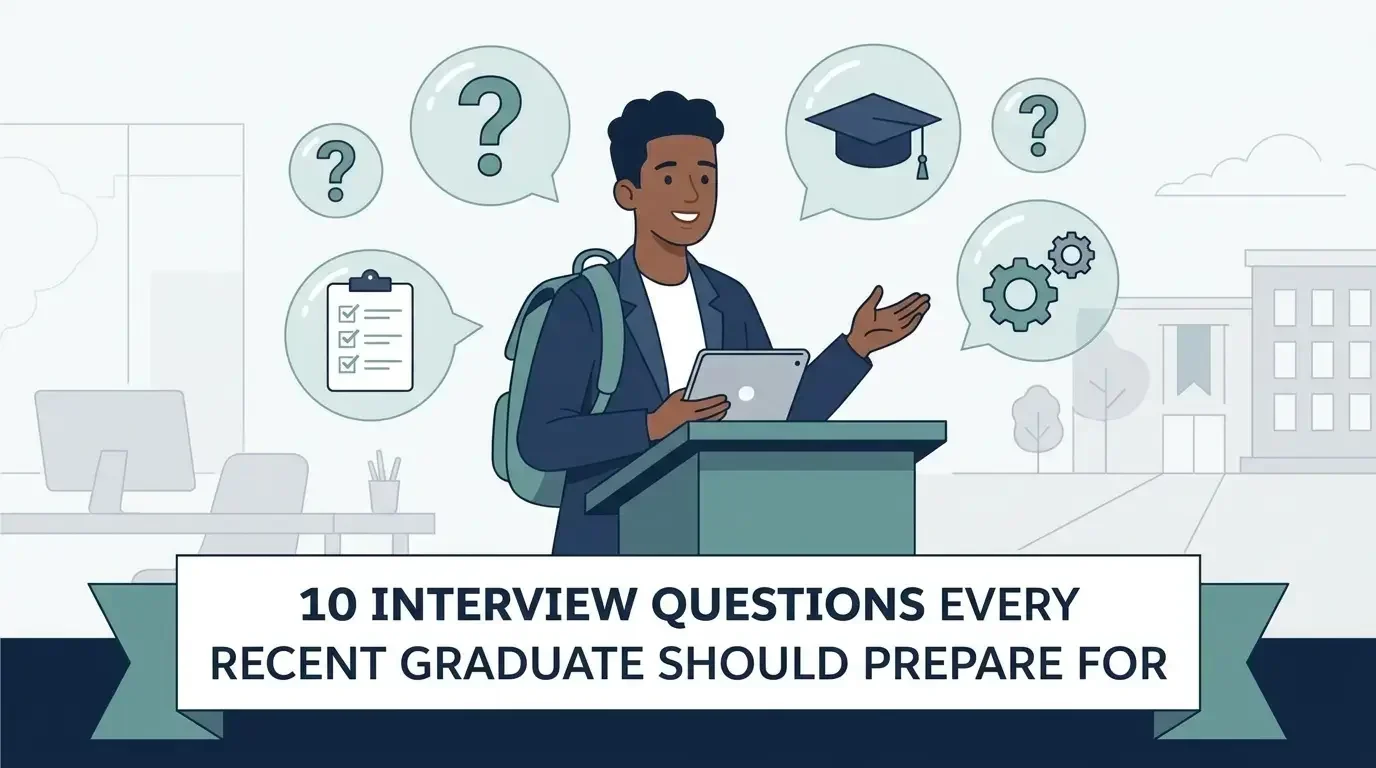
Most graduates walk into their first interview having prepared for the wrong questions. They rehearse their entire work history, memorise their GPA, and practise a two-minute life story nobody asked for. Then the interviewer asks "tell me about a time you dealt with conflict" and they freeze.
The interview questions every recent graduate faces are predictable. Hiring managers at entry-level use the same shortlist because they're testing the same things: whether you can think on your feet, whether you understand yourself, and whether you'll be worth the investment of training. Prepare specific answers for each question below before your next interview. Not bullet points. Full answers. The graduates who get offers are the ones who've already said the words out loud at least three times before the interview starts.
How to Use This List
Each question below includes why interviewers ask it, what they're actually listening for, and a framework for structuring your answer. Under each framework is a worked example you can adapt. Don't memorise the examples word for word. Use them as a model for building your own answer around something real from your background.
For questions that ask about past behaviour, use the STAR method: Situation, Task, Action, Result. It keeps your answer specific, structured, and easy to follow. Aim for answers between 60 and 90 seconds. Shorter than that and you haven't said enough. Longer and you've started rambling.
The 10 Interview Questions Graduates Need to Prepare For
1. Tell Me About Yourself
This is the first question in roughly 9 out of 10 graduate interviews. It's not an invitation to recite your CV. It's a warm-up question designed to see how you present yourself under mild pressure.
Structure your answer in three parts: where you've come from (your degree and one relevant thing from it), what you've done that's relevant (a project, internship, or role), and why you're here (what you want next and why this company). Keep it to about 75 seconds.
Example: "I graduated in June with a degree in Marketing from the University of Lagos, where my final-year project focused on building an organic social media strategy for a local NGO. I grew their Instagram following by 1,200 in four months using a content calendar I built from scratch. I'm looking to bring that kind of hands-on approach to a brand with more reach, which is what drew me to this role specifically."
2. Why Do You Want to Work Here?
Interviewers ask this to separate people who actually want this job from people who want any job. The wrong answer is a compliment. The right answer is a specific observation.
Reference something real: a campaign they ran, a product they launched, a value from their website that connects directly to something you've done. One specific detail is worth more than three generic sentences about "culture" and "growth opportunities."
Example: "Your content team's shift to short-form video over the last two quarters caught my attention because it's exactly what I've been experimenting with in my own work. I built and ran a TikTok channel for my university society that hit 4,000 followers in six months. I want to do that kind of work at a scale where it actually moves a business metric."
3. What Are Your Greatest Strengths?
Don't say "hard-working," "passionate," or "a team player." Every candidate says those. They're opinions without evidence, and experienced interviewers tune them out immediately.
Pick one strength, name it specifically, and prove it with a single example. One credible example beats three vague claims every time.
Example: "I'm good at turning ambiguous briefs into clear plans quickly. In my final year, I was given a group project with almost no direction and four weeks to deliver. I created the project structure, assigned roles, and set up a shared tracker within the first 48 hours. We submitted two days early and scored the highest mark in our cohort."
4. What Is Your Greatest Weakness?
This question isn't a trap. It's a test of self-awareness and honesty. Saying "I work too hard" or "I'm a perfectionist" is a non-answer and interviewers know it.
Name a real weakness, explain the specific situation where it showed up, and describe what you've actively done to improve it. The improvement is what matters most.
Example: "I used to avoid asking for help because I didn't want to look like I didn't know what I was doing. During a group project last year, I spent three days stuck on a data problem I could have solved in an afternoon if I'd asked my lecturer earlier. Since then, I set a personal rule: if I've been stuck for more than two hours, I ask. It's made me significantly faster."
5. Tell Me About a Time You Worked in a Team
Interviewers want to know if you understand your role within a group, how you handle disagreement, and whether you take responsibility or deflect it. Use STAR. Be specific about what you did, not what "we" did.
Example: "During my third year, I worked in a team of five on a business simulation competition. Two weeks in, we disagreed on our pricing strategy. I suggested we run a quick analysis comparing both approaches against the simulation's historical data. I built the comparison in Excel overnight and presented it the next morning. The team went with my recommendation and we placed second out of eighteen teams."
6. Tell Me About a Time You Dealt With a Challenge or Failure
This question separates resilient candidates from fragile ones. Don't pick a fake challenge like "I worked too many hours." Pick something that genuinely went wrong. The point is not the failure. The point is what you did next.
Example: "I applied for a competitive internship in my second year and didn't get past the first interview. I asked for feedback, which most candidates don't do, and I found out my answers were too vague and generic. I spent the following month practising STAR-method answers with a friend. The next internship I applied for, I got it. I start in January."
7. Where Do You See Yourself in Five Years?
Interviewers ask this to gauge your ambition and whether this role fits into a logical career path. They're not expecting a precise plan. They're checking whether you've thought about your development at all.
Be honest and directional. Connect your answer to the role you're interviewing for and show that you see this job as a genuine stepping stone, not just a payslip.
Example: "In five years, I want to be leading campaigns end-to-end, from strategy through to execution and measurement. I'm not there yet and I know it. What I want in the next two to three years is to build the technical foundation, understanding data, understanding what actually drives results, so that when I step into a senior role, I'm ready for it. This position feels like the right place to build that."
8. Why Should We Hire You?
This is the question most graduates fumble because it feels like bragging. It's not. It's the most important question in the interview. You're being asked to make your case directly. Make it.
Connect your one strongest, most relevant result to the most important requirement in the job description. One sentence on what you bring, one sentence on the evidence, one sentence on what you'll do with it here.
Example: "You need someone who can produce content consistently and measure what's working. In my last project, I managed a content schedule across three platforms for four months, posted 3 to 4 times per week, and tracked performance weekly in a reporting spreadsheet I built myself. Engagement grew 340% by month three. That's the system I'd bring here from day one."
9. Do You Have Any Questions for Us?
Saying "no, I think you've covered everything" is one of the most damaging things you can do at the end of an interview. It signals low interest and low preparation. Always have two to three questions ready.
Avoid questions about salary, holidays, or benefits in a first interview. Ask about the team, the biggest challenge the role faces in the first 90 days, or how success is measured in the first six months. These questions show you're thinking about how to contribute, not just what you'll receive.
Strong questions to ask:
- "What does success look like in this role after the first 90 days?"
- "What's the biggest challenge the person in this role will face in the first few months?"
- "How does the team typically give and receive feedback?"
- "What do the people who've done well in this role have in common?"
10. Tell Me About a Time You Showed Initiative
This question is looking for proof that you act without being told to. Interviewers hiring graduates know they're taking a risk on someone unproven. A specific example of unsolicited initiative reduces that perceived risk significantly.
Pick an example where you identified a problem no one asked you to solve and solved it anyway. The scale doesn't have to be large. The independence does.
Example: "During my placement, I noticed the team was manually copying data between two spreadsheets every Monday morning, which took about 90 minutes each time. Nobody had complained about it because it was just how it was done. I spent a lunch break building a formula that automated the process and took it from 90 minutes to about 4 minutes. My manager hadn't asked me to do it. She used it every week for the rest of my placement."
How to Practise So Your Answers Actually Land
- Say your answers out loud, not just in your head. Reading over notes feels like preparation. It isn't. Your brain processes spoken answers differently, and the first time you say something out loud should not be in the interview room.
- Record yourself on your phone for at least two questions. Watch it back. You'll immediately identify where you're rambling, where you lose eye contact, and where your answer loses structure.
- Time every answer. Aim for 60 to 90 seconds per question. Use your phone's stopwatch. Answers under 45 seconds are too thin. Answers over 2 minutes are too long.
- Practise with someone who will actually interrupt you and ask follow-up questions. Interviewers rarely let you finish a monologue uninterrupted. Get comfortable being redirected mid-answer.
Common Interview Mistakes That Cost Graduates the Offer
- Giving the same example for every behavioural question. Interviewers notice. Prepare at least four to five different stories from your background so you're not recycling the same project for every STAR question.
- Waiting until the night before to prepare. Preparation the night before handles nerves but not quality. The quality of your answers improves with repetition over days, not hours.
- Forgetting to research the company before walking in. If you can't answer "why do you want to work here" with something specific, you've already lost ground that's almost impossible to recover in the same interview.
Frequently Asked Questions
How many interview questions should I prepare for?
Prepare answers for the 10 questions in this list, plus two or three role-specific questions based on the job description. For most entry-level roles, that's 12 to 14 prepared answers. You won't be asked all of them, but knowing you have a strong answer ready for any direction the conversation takes eliminates the kind of nerves that kill otherwise good interviews. Preparation doesn't make you sound rehearsed. It makes you sound confident, and interviewers read confidence as competence.
Is it okay to use notes during a video interview?
Yes, but carefully. Keeping a single page of bullet points off to the side is acceptable in a video interview. What's not acceptable is reading from them visibly, looking away from the camera for more than a second or two, or shuffling papers audibly. If you're relying on notes to remember your own experience, your preparation wasn't deep enough. Use notes as a safety net, not a script. The best use of notes in a video interview is having the job description open so you can reference specific requirements when answering "why should we hire you."
What should I do if I don't know the answer to a question?
Say so, briefly, then bridge to what you do know. "I haven't encountered that specific situation yet, but here's how I'd approach it" is a strong response. Bluffing through an answer you don't have is not. Interviewers can tell when a candidate is waffling, and it creates a worse impression than a confident acknowledgment of a knowledge gap. For behavioural questions where you genuinely have no relevant experience, use a hypothetical and label it clearly: "I haven't faced that directly, but based on how I handled X, I'd approach it by..."
How early should I arrive for an in-person interview?
Arrive at the building 10 to 15 minutes early. Not 30 minutes early. Not exactly on time. Arriving 30 minutes early creates awkwardness for the receptionist and the interviewer. Arriving exactly on time leaves no margin for anything going wrong in the lobby, the lift, or the sign-in process. Ten to fifteen minutes gives you time to settle, use the bathroom, review your notes once, and arrive at the interview room composed rather than rushed. If you're travelling somewhere unfamiliar, do a test run the day before.
Start Preparing Today, Not the Night Before Your Interview
Open a notes app right now and write down one example from your background for questions 3, 5, 6, and 10 on this list. Those four are the ones graduates are most likely to freeze on. Getting those four answers solid gives you the foundation everything else builds on.
Once your answers are ready, make sure the rest of your application holds up just as well. Read our guide on how to write a resume with no experience and our walkthrough on how to write a cover letter that actually gets read to make sure you're walking into every interview already ahead of the competition.